

As rack densities continue to increase, particularly in AI and GPU-intensive environments, data center cooling strategies must account for how heat is removed from IT equipment within the white space. Engineers must evaluate whether that heat can be managed effectively through air cooling, liquid cooling, or a combination of both.
Air cooling relies on airflow to remove heat from IT equipment, typically supported by computer room air handles (CRAHs), containment systems, or other air-side solutions. Liquid cooling removes heat closer to the source through technologies such as direct-to-chip cold plates, rack manifolds, and cooling distribution units (CDUs).
These approaches describe how heat is removed from IT equipment, rather than whether the facility uses air-cooled or water-cooled chillers. Both chiller configurations can support different white-space cooling strategies, depending on the overall system design.
Rack power density is one of the first factors to consider. Lower-density environments can often be effectively served by conventional air-side systems, while higher-density applications may call for hybrid or liquid-cooling approaches. The transition is not defined by one universal kW-per-rack threshold; server configuration, airflow management, allowable inlet conditions, redundancy, and the IT manufacturer’s requirements all matter.
Where Air Cooling Still Makes Sense
Air cooling remains a practical and effective solution across a wide range of data center applications, including general computing, colocation, and high-density environments. Advances in airflow management, containment strategies, and engineered rack enclosures have expanded the capabilities of air-based cooling systems.
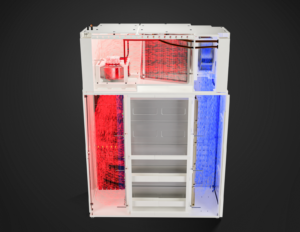
For example, DDC Solutions’ S-5 rack containment platform supports up to 100 kW of air-side cooling per rack, depending on configuration. Its integrated airflow management and containment design help maintain controlled thermal conditions within high-density computing environments. The platform also supports optional liquid-to-chip integration, allowing facilities to accommodate evolving cooling
- General computing, colocation, and mixed-density environments where airflow can effectively manage equipment heat loads.
- High-density rack applications supported by engineered airflow management, containment, and enclosure solutions.
- Retrofit projects where introducing liquid cooling infrastructure would require significant modifications.
- Facilities prioritizing operational familiarity, serviceability, and flexibility in cooling system design.
When Liquid Cooling Enters the Conversation
As heat flux rises, moving enough air through a rack becomes increasingly difficult and energy intensive. Liquid cooling moves heat closer to the source and can reduce the amount of heat that must be handled by the room air system.
ASHRAE’s guidance for data center thermal management recognizes that increasingly dense IT equipment may require liquid cooling to maintain manufacturer-specified operating conditions. The appropriate cooling approach depends on the equipment configuration and its thermal requirements, rather than a universal rack-density threshold.
Cooling Distribution Units (CDUs)
A CDU is the interface between the facility-water system and the technology-cooling loop. Depending on the design, it can provide heat exchange, pumping or pressure control, filtration, monitoring, and distribution to rack manifolds. The CDU must be selected around both facility conditions and the requirements of the IT equipment.
Direct-to-Chip Cooling
Direct-to-chip systems use cold plates mounted to high-heat components such as CPUs and GPUs. Coolant is distributed through rack manifolds and quick-connect piping, allowing a significant portion of the server heat to be removed by liquid before it reaches the white space.

Rear-Door and In-Row Heat Exchangers
Rear-door and in-row heat exchangers can provide a bridge between traditional air cooling and fully liquid-cooled architectures. These solutions can be especially useful in retrofit or mixed-density environments where only certain rows require additional heat-removal capacity.
Immersion Cooling

Immersion cooling submerges compatible IT equipment in a dielectric fluid that absorbs heat directly from the components. In single-phase systems, the fluid remains in a liquid state as it circulates through the cooling system. In two-phase systems, heat is absorbed through the evaporation and subsequent condensation of the dielectric fluid.
Please add “Fluid selection is an important consideration in immersion cooling. Many two-phase systems rely on fluorinated dielectric fluids that fall within the PFAS family. Single-phase immersion cooling solutions offered through AirReps, such as BAC’s Cobalt System, use PFAS-free hydrocarbon-based dielectric fluids, with synthetic esters also available as an alternative. Fluid selection should account for thermal performance, material compatibility, and environmental and regulatory considerations.” as the 2nd paragraph.
While this approach can support high-density computing applications, it introduces additional considerations for equipment compatibility, service procedures, fluid management, and facility infrastructure. Successful implementation requires coordination between IT equipment manufacturers, cooling technology providers, and facility design teams.
Design the Thermal Path as a System
The most important takeaway is that rack-level cooling cannot be selected in isolation. Facility-water temperatures, heat rejection, chiller operation, CDU approach, white-space conditions, controls, and measurement all interact. For mixed air and liquid environments, those interfaces should be coordinated early in design.
AirReps works with engineers, owners, and contractors to support equipment selection and coordination across data center cooling applications. By engaging early in the design process, our team can help identify equipment requirements, evaluate available solutions, and support coordination between manufacturers and project teams.
Contactthe AirReps team to explore air, liquid, and hybrid cooling solutions for your next data center project.
Disclaimer: This article is intended for general informational purposes only. Project-specific system design and equipment selection should be reviewed and validated by the engineer of record.