
As commercial buildings move toward all-electric heating and cooling, air-to-water heat pumps (AWHPs) are becoming an increasingly important option for hydronic system design. For some applications, VRV provides an efficient and flexible path to electrification. In others, a hydronic approach may be a better fit.
With an AWHP system, the refrigerant circuit remains at the outdoor equipment and water becomes the distribution medium inside the building. This changes where refrigerant is located, but it does not eliminate system-design complexity. The heat pump plant still has to coordinate equipment operation, pumps, valves, buffer tanks, controls and the building automation system (BAS).

Why Hydronic Heat Pump Systems Become Complex
Hydronics are flexible, but that flexibility introduces more variables into the system design. AWHPs can differ in refrigerant, compressor configuration, fans, circuiting, ambient operating performance and defrost strategy. Piping and pumping arrangements can also vary from one application to another.
Those differences matter when the sequence of operations (SOO) is developed. With many hydronic heat pump plants, the design engineer and controls contractor must coordinate the SOO around the operating requirements and mechanical limitations of the selected equipment. Compressor staging, pump operation, valve positions, defrost response and other plant functions all have to work together.
By comparison, VRV heat pump and heat recovery systems typically place much of the mechanical control logic within the manufacturer’s controls. Equipment response, staging and defrost logic are developed and tested around the system, while the BAS communicates the zone requirements. Keeping that control responsibility with the manufacturer creates a clearer division between equipment-level control and building-level control and gives the project team a more defined responsibility matrix during commissioning.
For an AWHP plant, that same clarity is critical. When the manufacturer’s equipment requirements, the engineer’s sequence of operations and the controls contractor’s programming are not aligned, the plant can become difficult to commission and troubleshoot. AirReps has seen relatively new hydronic heat pump installations struggle when the responsibility matrix failed to account for equipment operating limits and required control responses. The result can be extended troubleshooting, costly rework and, in severe cases, equipment damage. The technical challenge is therefore not simply selecting a heat pump; it is defining who controls each part of the plant and ensuring the SOO reflects how the equipment is designed to operate.

How Nyle Tero Simplifies Plant Controls
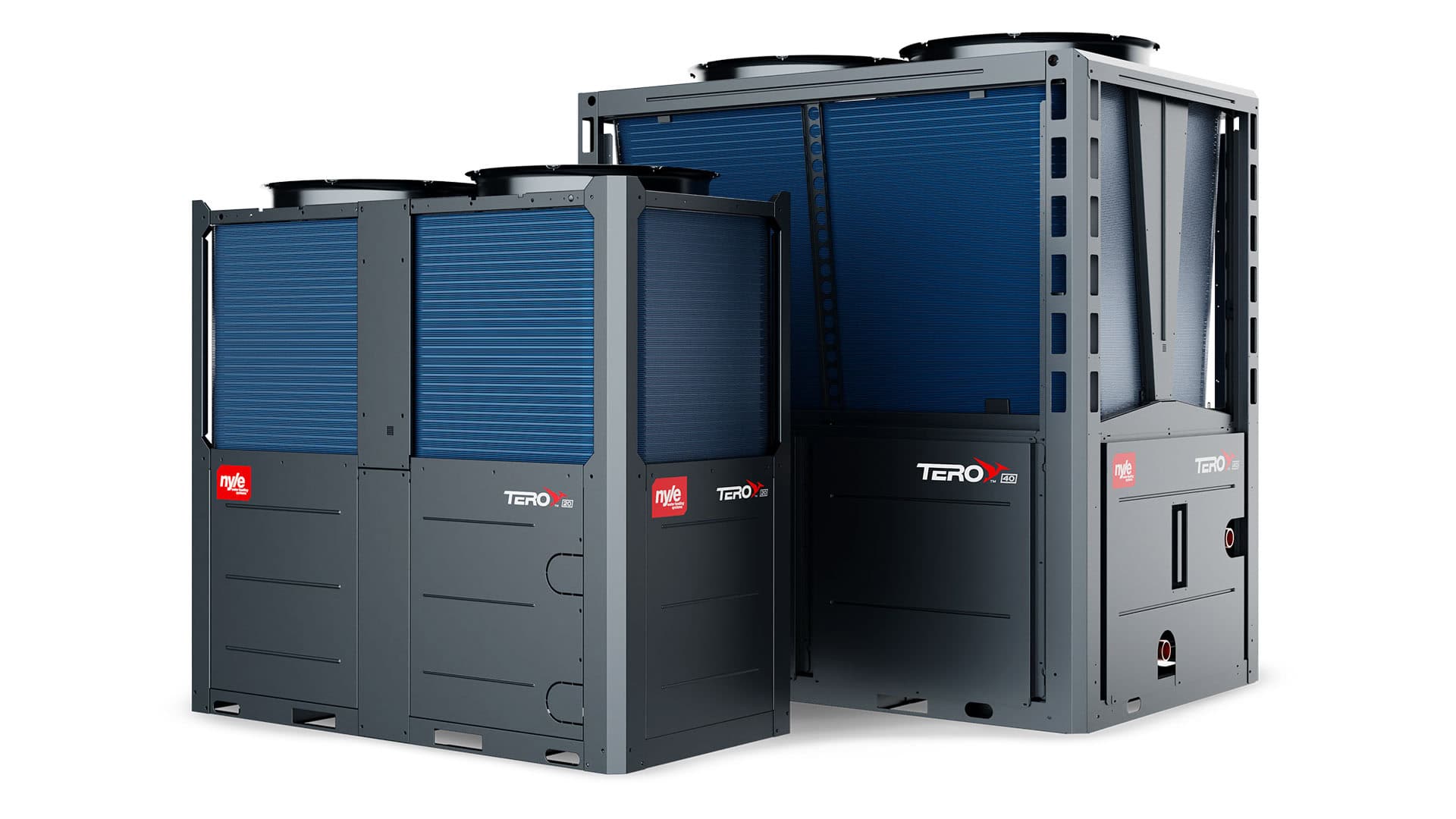
The Nyle Tero system addresses this coordination by incorporating onboard controls, integral pumps and the sensors required to operate the mechanical system. The equipment controls remain with the manufacturer rather than requiring the BAS to recreate the heat pump plant logic.
At the plant level, the BAS provides the Tero array with a call for heating or cooling, and the equipment controls respond accordingly. The BAS does not have to build custom sequences for compressor staging, valve actuation, defrost response, pump control or head-pressure control.
The Tero units produce hot or chilled water into a buffer tank, and that water is then distributed through the building. This allows the controls contractor to focus on the building side of the system, including zone response, comfort and distribution, while the heat pump plant manages equipment-level operation.
That distinction is especially important when evaluating overall system performance. Optimizing terminal and distribution controls is only part of the equation; the production plant also needs to maintain efficient operation across changing loads, ambient conditions and defrost cycles. A well-tuned building-side system cannot compensate for a production plant that is being controlled outside the operating strategy intended by the equipment manufacturer.
Hydronic Piping and System Integration

Controls are only one part of a successful hydronic heat pump project. Piping configuration and component selection also affect how the plant operates and how easily it can be installed and commissioned.
Nyle engineering reviews Tero projects to define the piping components required for the application. Through AirReps, project teams can also coordinate components such as control valves, check valves, buffer tanks and glycol-management equipment. Pipe kits and skid solutions can bundle, pre-pipe or mount these accessories to reduce field coordination and installation requirements.
The objective is a coordinated system approach in which the heat pump equipment, piping components, controls and accessories are selected around the operating requirements of the plant rather than treated as independent pieces.
Coordinating the Complete Heat Pump Plant
The intended result is an experience closer to a factory-coordinated HVAC system: equipment controls are defined by the manufacturer, required hydronic components are identified during application review, and the project team has a clearer understanding of the materials, control boundaries and responsibilities required for operation. That clearer division of scope is intended to reduce the gaps that can otherwise develop between equipment selection, the engineered SOO and field controls programming.
For engineers, this can reduce the amount of custom plant logic that must be developed around individual heat pump operating limitations and provide a clearer basis for the SOO. For contractors and controls teams, coordinated equipment, piping components and control responsibilities can reduce uncertainty during installation, startup and commissioning. For building owners, manufacturer-managed plant controls provide a clearer path for verifying that the production plant is operating as intended while the BAS focuses on building comfort and distribution.
Technical Takeaway
Air-to-water heat pumps provide a flexible path to building electrification, but successful application depends on more than heat pump selection. Equipment controls, sequence of operations, pumping, valves, buffer tanks and BAS integration all have to be considered as one system.
Nyle Tero is designed to simplify that coordination by combining air-to-water heat pump technology with manufacturer-owned plant controls, integral pumping and a defined hydronic system approach. AirReps can support the project team with equipment selection, application coordination, piping components, pipe kits and skid solutions to help carry the design from concept through installation and commissioning.