
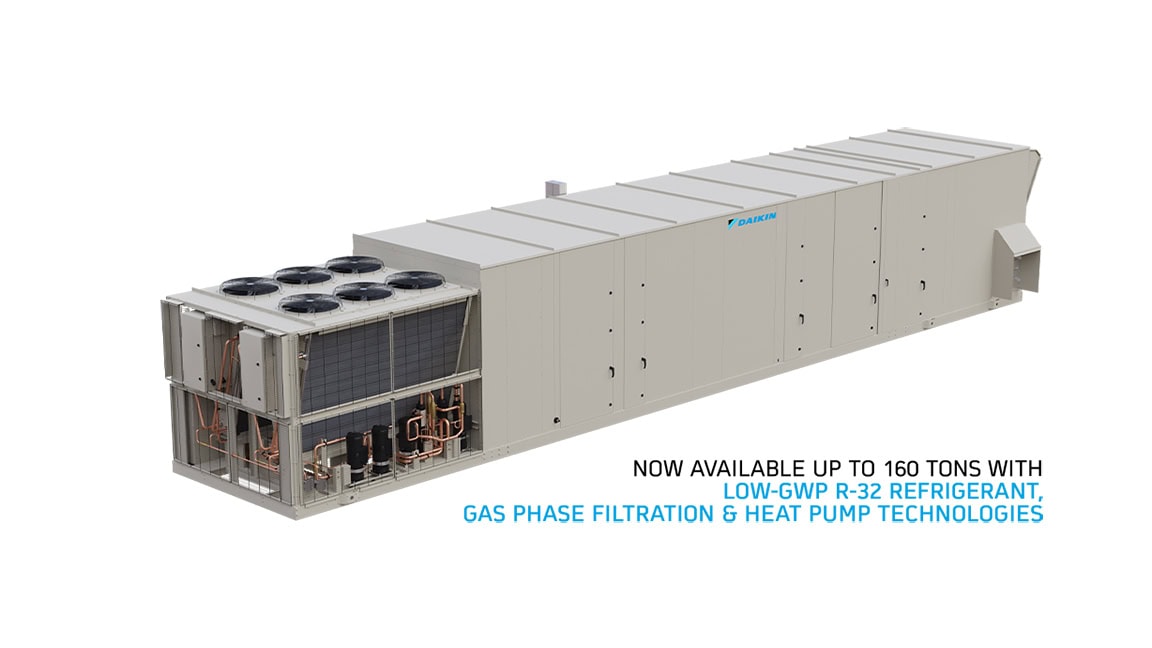
With the HVAC industries transition to lower Global Warming Potential (GWP) refrigerants, A2L refrigerants have become the current standard in commercial rooftop systems. While these refrigerants offer environmental advantages, they also introduce new safety requirements due to their mildly flammable classification. Daikin Applied’s Rebel and Rebel Applied Packaged Rooftop Units, equipped with the MicroTech® Unit Controller, address these challenges through a sophisticated A2L leak detection and mitigation system designed to maintain safety, system reliability, and compliance.
What Is the A2L Leak Detection System?

Daikin’s factory-installed A2L leak detection system continuously monitors refrigerant concentrations within the unit using up to eight refrigerant sensors connected in a daisy-chain configuration to a dedicated A2L Leak Detection Control Board. This board communicates directly with the MicroTech controller via Modbus, allowing the rooftop unit to automatically respond to leaks or sensor faults.
The system activates alarms under two primary conditions:
- Refrigerant Leak Detection: Triggered when refrigerant concentration exceeds 15% of the refrigerant’s Lower Flammability Limit (LFL).
- Sensor Fault Detection: Triggered when a sensor malfunctions, loses communication, or fails self-diagnostics.
How the MicroTech Controller Responds to a Refrigerant Leak
When a refrigerant leak is detected, the system prioritizes occupant safety while maintaining ventilation:
If the Unit Is Enabled:
- Refrigerant leak alarm is triggered and will remain on until unit alarm is manually cleared
- Compressors immediately shut down and are locked out
- Supply fan minimum speeds are overridden to ensure sufficient airflow for refrigerant dilution
- Manual control operation is disabled
- Gas or electric heat cold start functions are disabled
If the Unit Is Disabled:
- Compressors remain locked out
- Supply fan activates automatically unless prevented by critical alarms such as E-Stop or supply fan faults.
- VAV box digital output opens (to open boxes)
- Heating and cooling functions are disabled
Once refrigerant is no longer detected for five minutes, the system can return to its previous state, but compressor lockout remains until the alarm is manually cleared.
Sensor Faults: Safety Without Full Shutdown
A faulty sensor doesn’t necessarily mean a refrigerant leak, but Daikin’s system treats the issue seriously:
- A sensor fault alarm is generated.
- Ventilation airflow is increased as a precaution.
- Compressors may remain disabled depending on operating mode.
- The system continues mitigation until repairs are completed and alarms are manually reset.
This design ensures that even if the detection system itself encounters issues, safety remains the top priority.
Minimal Maintenance, Maximum Reliability

One major advantage of Daikin’s A2L detection system is its low maintenance profile:
- Sensors are not considered limited-life components.
- No routine maintenance is required under normal operation.
- Built-in diagnostics continuously monitor sensor and board health.

For technicians, the control board also offers onboard diagnostics, including:
- Active sensor detection
- Last 10 fault logs
- Live LFL readings
- Automated mitigation testing
- Diagnostic & configuration values via onboard LCD display
Why This Matters for Building Owners and Service Teams
A2L refrigerants are shaping the future of HVAC, and systems like Daikin’s MicroTech controller help bridge sustainability with operational safety. By integrating automated leak response, sensor fault management, and technician-friendly diagnostics, Daikin reduces risk while minimizing downtime.
Final Thoughts
As refrigerant regulations evolve, understanding A2L safety systems is essential for facility managers, contractors, and service technicians. Daikin’s MicroTech A2L detection and mitigation platform demonstrates how modern rooftop units can safely adapt to the next generation of refrigerants without compromising performance.
For HVAC professionals, mastering these systems now means being better prepared for the industry’s future. Here at AirReps, we’re experts when it comes to these products and many more. To connect, email us today at [email protected].