
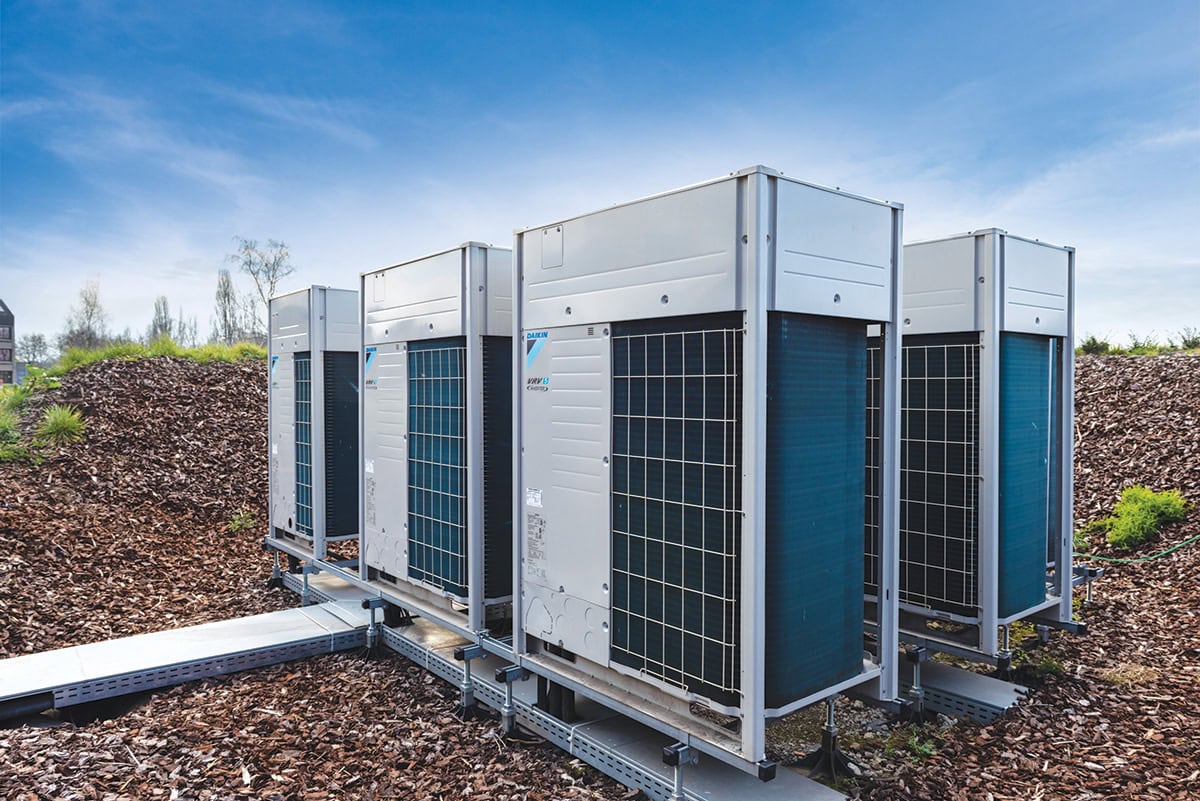
Our team of HVAC experts at AirReps has now been through several Daikin VRV projects across Washington under A2L requirements, and the process is starting to become more consistent. The code framework itself, including the 2021 IMC and ASHRAE 15, is well established. What has taken some time is understanding how those requirements show up in real projects through design, plan review, and installation.
From both a design and field perspective, a few things have become clear.
New Construction: Straightforward with Early Planning
In new construction, A2L has not been the obstacle many expected. The key difference is the ability to plan for it from the beginning.
When refrigerant concentration limits under IMC 1105 are evaluated during design, most VRV systems can be configured to stay within allowable thresholds without significant redesign. Issues tend to arise when these calculations are addressed too late, after the system layout has already been defined.
From a Daikin VRV standpoint, three items have consistently made the process more predictable.
The first is using Web Express early in design. Modeling the system to understand total refrigerant charge and comparing that to the smallest occupied room volume provides immediate clarity. It allows the design team to identify potential issues before they become submittal or permit challenges.
The second is branch box location. Placement has a direct impact on refrigerant distribution and the largest connected circuit. Adjusting branch box locations can significantly reduce the effective refrigerant serving smaller spaces. In many cases, this is the simplest way to bring a system into compliance.
The third is the use of branch box enclosures with venting when required. When systems approach allowable limits, these enclosures provide a defined space to manage refrigerant and offer a clear, code-compliant solution. When properly documented, this approach has been well received during plan review.
When these considerations are incorporated early, A2L becomes another design parameter. It is no different than working through airflow, zoning, or ventilation requirements. It simply needs to be addressed upfront.

Retrofit Projects: More Coordination Required
Retrofit work presents a different set of challenges.
The primary issue is that A2L requirements are being applied to buildings that were not originally designed around refrigerant concentration limits. The complexity is not in the equipment, but in how the existing building conditions interact with current code requirements.
One of the largest areas of uncertainty is coil replacement. When replacing indoor units or coils within an existing system, jurisdictions are not always aligned on whether the entire system must be re-evaluated under IMC 1105. Some treat this as a full system review, while others limit the scope to the work being performed. Until there is more consistency, early coordination with the AHJ is critical.
Several additional challenges are showing up consistently.
Room volume is a frequent constraint. Older buildings often have smaller rooms, which can bring refrigerant concentrations closer to allowable limits. Daikin has safety shut off valves built into the branch box. That gives it a distinct advantage over other solutions when calculating the load. The branch box itself does have to consider the total refrigeration volume. Unlike new construction, there is limited flexibility to modify layouts or redistribute zones without impacting the building.
Ventilation is another factor. Adding mechanical exhaust or increasing airflow can be difficult in existing buildings. What appears to be a simple mitigation strategy on paper can quickly expand into a larger construction scope involving routing, controls, and electrical work.
Partial system modifications also require careful attention. Replacing only a portion of a VRV system can unintentionally change refrigerant distribution. This may require a broader system evaluation than originally anticipated to ensure compliance.
In response, we are seeing more projects take a different approach to system design. In situations where distributed refrigerant becomes difficult to manage, shifting portions of the system to hydronic systems or a water cooled VRV can be an effective solution. Moving refrigerant out of occupied spaces reduces exposure to refrigerant concentration limits and can simplify the overall compliance strategy.
The key takeaway for retrofit projects is that success depends more on coordination than calculation. Early alignment between the engineer, contractor, and AHJ is essential to avoid delays and redesign during later phases of the project.
Final Thoughts
HVAC design has never been one-size-fits-all, and A2L reinforces that reality.
Every project brings a different combination of building constraints, system requirements, and code interpretation. In some cases, VRV is the right solution. In others, a hydronic approach may provide a better path. Often, a combination of both delivers the best result.
The projects that are moving most efficiently are the ones where teams evaluate these factors early and select the system that best fits the application. Taking that approach leads to better alignment between design, compliance, and constructability.
That has always been true in this industry. A2L simply makes it more important to get those decisions right at the start. Working with AirReps is a guarantee that our team is factoring all these important needs and more to give you the right custom HVAC solutions from start to finish. To work with the HVAC experts at AirReps, reach us today at [email protected].