

Here at AirReps, our team of HVACR experts hears it all! We’re always answering questions about HVACR systems that are facing issues in running properly. Every so often we get a call from a customer wondering why their turbine meter isn’t working, or why the flow rate is significantly different than what they might expect it to be.
When it comes to these complex challenges, there are usually two scenarios that cover 95% of these issues.
The first reason we typically see would be that there is something restricting or stopping the turbine(s) from spinning with the flow. Dual turbine meters use an average of both turbines, so if the meter is only operating at half of the flow, it should be, it’s possible that one turbine is “stuck.” An easy way to determine if this is the problem is to take the cover off the meter head and watch the diagnostic LEDs.
Inside, there are four LEDs on the edge of the circuit card, as shown in figure 1. For dual turbine meters, watch the White and Orange LEDs. If you have the recommended minimum straight pipe, these two LEDs will flash at a very similar rate. If one of them is not flashing, you have a very good indication that the associated turbine is stuck. If you have a single turbine meter, you most likely see that the Green LED is not flashing with the flow rate.
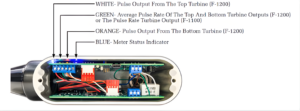
figure 1
Another hint here is if the white LED is not flashing, look at how the meter was installed. If the installer used Teflon tape instead of paste, there is a high probability that some of the tape has been sucked down through the ball valve and is wrapped around the top turbine shaft, preventing the turbine from spinning. For this reason, we suggest that Teflon tape is never used with Turbine meters!
If these steps do not rectify the issues, the next step would be to remove the meter and inspect the turbines. If you turn the meter so that you can gently blow with the turbine shaft, the turbines should spin freely. If the turbines do not spin, look for debris that might be preventing them from spinning, as seen in figure 2.
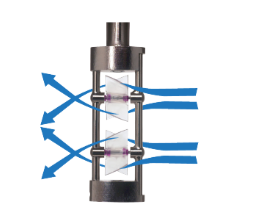
figure 2
Here at AirReps, we work closely with our partners at ONICON, who offer turbine meter services if these steps have been exhausted and you are still unable to get the turbines to spin. Contact us on our website to help arrange an RMA so that it can be shipped back if needed.
The second most common reason for a discrepancy in flow reading is a mismatch in what the meter was ordered for, versus what it was installed in.
These meters are measuring the velocity of the fluid and based on the pipe material and size, are calculating the GPM. If the meter was ordered for a 4” carbon steel pipe but was installed in a 3” copper pipe, the flow rate will not be correct. It’s important to look at the pipe size and material and compare this to the meter tag information. If they do not match, we need to make a change to the meter configuration. The beauty of ONICON’s turbine meters is that this can easily be resolved in the field.
Go to ONICON’s website and download the Turbine Meter Configuration Tool. This software will allow you to change pipe size, pipe material, maximum flow range and a few other parameters. Install this software on your laptop and then connect to the meter using a USB cable. Details on this process are documented in the operation guide, which can also be found on ONICON’s website.
One last piece of information concerning these meters is shown in figure 1. This shows a blue LED that represents the meter status. This LED changes the flash rate based on some basic diagnostics within the meter, as seen below. While this is rather general information, if you are seeing anything other than the normal flash rate, you can connect your laptop using the Configuration Tool and it will provide more information on what the alarm or warning is.
How to read the blinking pattern:
Status LED (BLUE)
-
Normal Status – 500ms ON, 500ms OFF
-
Warning Status – 2 rapid blinks, then 500ms OFF
-
Alarm Status – 3 rapid blinks, then 500ms OFF
-
Error Status – 4 rapid blinks, then 500ms OFF
Our team of experts here at AirReps has been creating and servicing custom HVAC solutions for over 50 years. Here on our blog, our goal is to share our expertise, to help others get the most out of their HVACR system. If you require more information or assistance, please feel free to reach out to our team through our website today!